> For the complete documentation index, see [llms.txt](https://primer2.dynamobim.org/llms.txt). Markdown versions of documentation pages are available by appending `.md` to page URLs; this page is available as [Markdown](https://primer2.dynamobim.org/dynamo-in-forma-beta/add-and-share-graphs-in-dynamo-player.md).
# Add and Share Graphs in Dynamo Player
Once you have set up Dynamo Player, you can open files in Player. If you're using the desktop version, you'll also need to have Dynamo open.
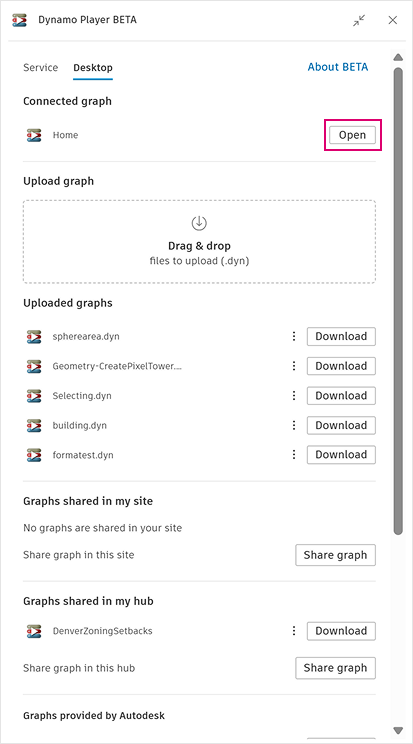
Open a connected graph in Dynamo Desktop
If you are using Dynamo Desktop, Player will recognize a graph that's currently open in Dynamo and give you the option to open it in Player.
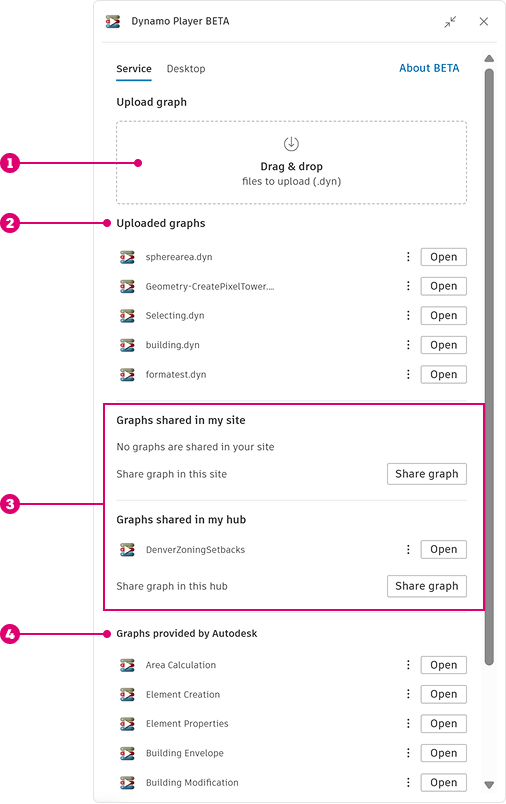
On both the Service and Desktop tabs, you'll find an area labeled **Upload graph** \[ 1 ] where you can drag and drop .dyn files to add them to Player. Alternatively, click the area to open a dialog to browse and add files.
Graphs you upload appear under **Uploaded graphs** \[ 2 ]. You can open the graph or click the options menu (three dots) to remove, download, or share the graph.
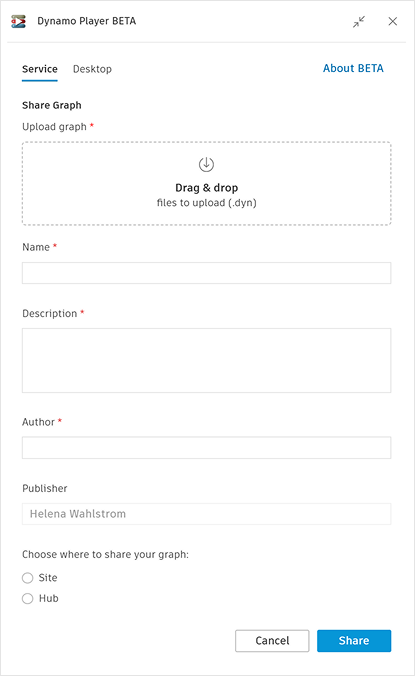
Graphs can be shared to a site or a hub \[ 3 ]. A hub includes multiple sites. To share a graph, click **Share graph** and enter graph details. You can choose whether to share the graph to the site or hub. Once you click **Share**, the graph becomes available to other users with access to that site or hub.
Sharing a graph
Dynamo Player comes with several pre-built graphs in the **Graphs provided by Autodesk** section \[ 4 ]. These are a great starting point for exploration and experimentation!