> For the complete documentation index, see [llms.txt](https://primer2.dynamobim.org/llms.txt). Markdown versions of documentation pages are available by appending `.md` to page URLs; this page is available as [Markdown](https://primer2.dynamobim.org/zh-tw/dynamo-for-civil-3d/sample-workflows/surveying/point-group-management.md).

# 點群組管理

<figure><img src="/files/QUatbEVHW85UpDQf20c9" alt=""><figcaption></figcaption></figure>

對於許多從測量現場到完成工作的流程而言，在 Civil 3D 中使用 COGO 點和點群組是核心要素。Dynamo 在資料管理方面非常出色，我們將在此範例中示範一個可能的使用案例。

## 目標

> :dart: 為每個唯一的 COGO 點描述建立點群組。

## 主要概念

> * 使用清單
> * 使用 **List.GroupByKey** 節點將類似物件分組
> * 在 Dynamo 播放器中展示自訂輸出

## 版本相容性

{% hint style="success" %}
此圖表將在 \*\*Civil 3D 2020\*\* 及更高版本上執行。
{% endhint %}

## 資料集

首先，下載以下範例檔案，然後開啟 DWG 檔案和 Dynamo 圖表。

{% file src="/files/ZC3DVS4eaGp6ZQVqAtn3" %}

{% file src="/files/Kx4eerjbDucW4rxADYio" %}

## 解決方法

以下是此圖表中的邏輯概觀。

> 1. 取得文件中所有的 COGO 點
> 2. 依描述將 COGO 點分組
> 3. 建立點群組
> 4. 將摘要輸出至 Dynamo 播放器

我們開始吧！

### 取得 COGO 點

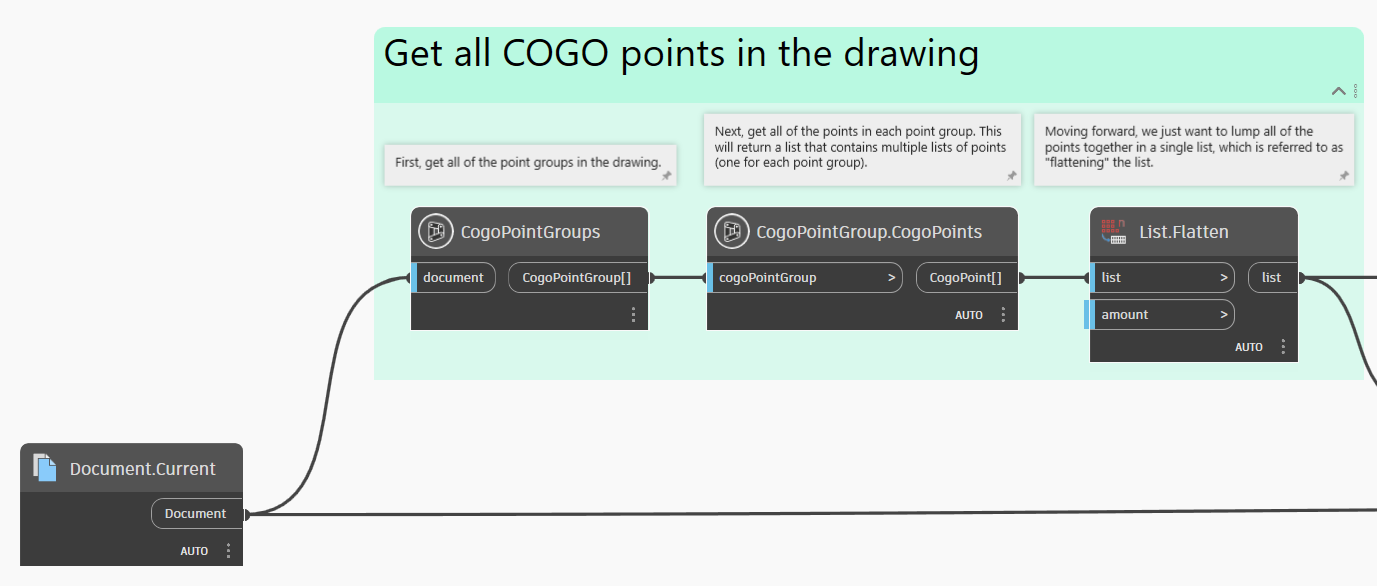
第一步是取得文件中所有的點群組，然後取得每個群組內的所有 COGO 點。這會產生一個 *巢狀清單* ，也就是「清單的清單」，如果稍後使用 **List.Flatten** 節點將所有內容向下展開為單一清單，會更容易處理。

{% hint style="info" %}
如果您不熟悉使用清單，請查看 [使用清單](/zh-tw/5_essential_nodes_and_concepts/5-4_designing-with-lists/2-working-with-lists.md) 一節。
{% endhint %}

<figure><img src="/files/nqc4Cq6TDxQDUYUkHXky" alt=""><figcaption><p>取得所有點群組和 COGO 點</p></figcaption></figure>

### 依描述將點分組

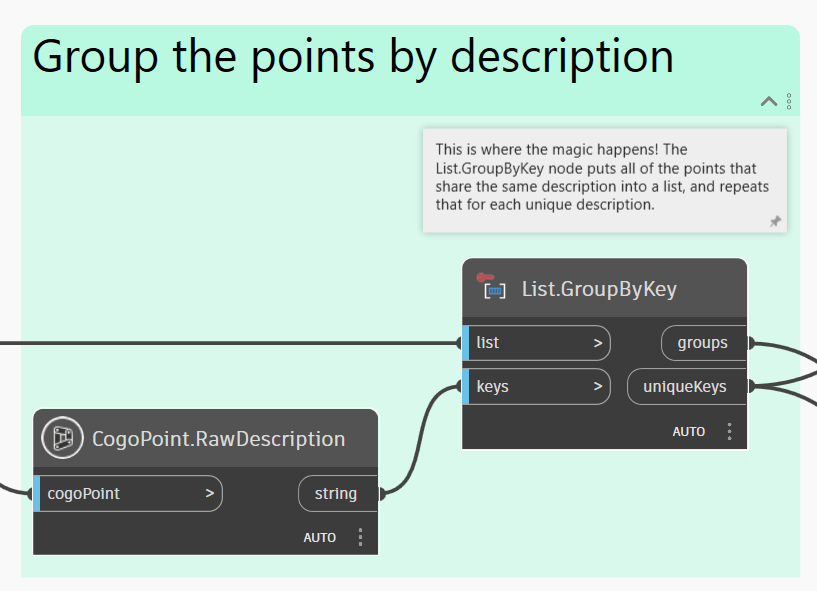
我們現在已有全部的 COGO 點，需要根據其描述分為多個群組。這正是 **List.GroupByKey** 節點所做的工作。它基本上會將共用相同鍵的所有項目分組在一起。

<figure><img src="/files/eztnlDKBPZ2bnIxes8r9" alt="" width="563"><figcaption><p>依描述將 COGO 點分組</p></figcaption></figure>

### 建立點群組

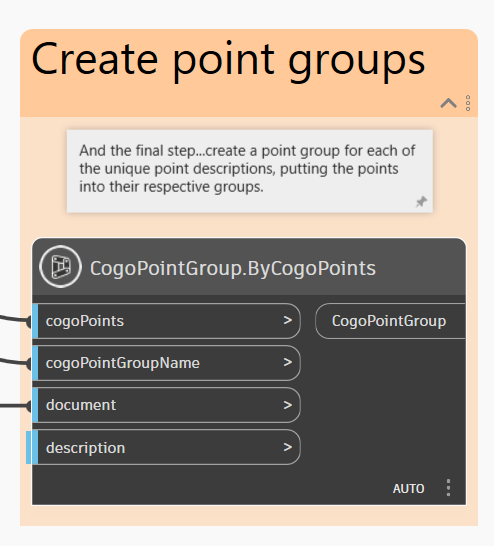
辛苦的工作已經完成！最後一步是從分組的 COGO 點建立新的 Civil 3D 點群組。

<figure><img src="/files/2uo37VX1QVY5ZdUncNKh" alt="" width="371"><figcaption><p>建立新的點群組</p></figcaption></figure>

### 輸出摘要

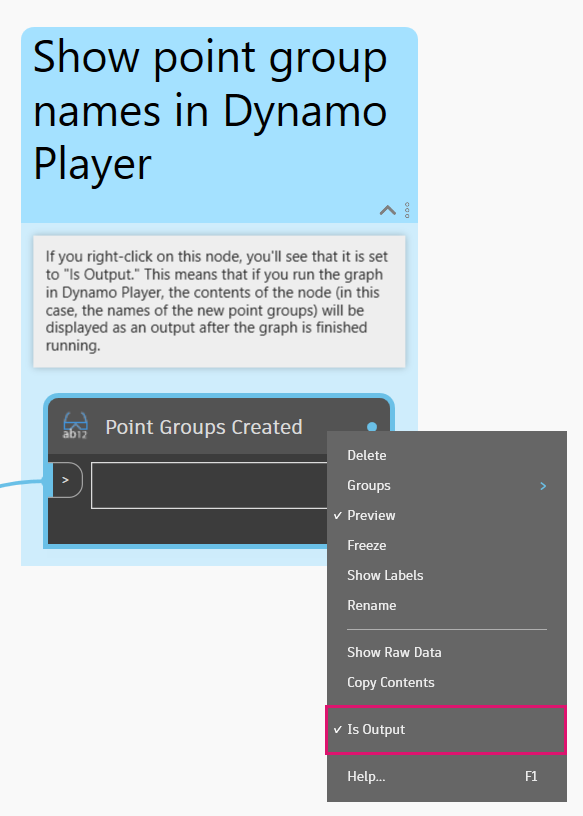
當您執行圖表時，Dynamo 背景預覽中沒有任何內容可供查看，因為我們沒有處理任何幾何圖形。因此，查看圖表是否正確執行的唯一方法是檢查「工具區」，或查看節點輸出預覽。但是，如果我們使用 **Dynamo 播放器**執行圖表，則可以透過輸出已建立的點群組摘要，提供更多有關圖表結果的回饋。您只需在節點上按一下右鍵，然後設定為 *「是輸出」* 即可。在此範例中，我們使用更名過的 **Watch** 節點來檢視結果。

<figure><img src="/files/PEZZfHxCeGWm8WusrX7Y" alt="" width="437"><figcaption><p>將節點設定為<em>「是輸出」</em>，將在 Dynamo 播放器輸出中顯示其內容</p></figcaption></figure>

### 結果

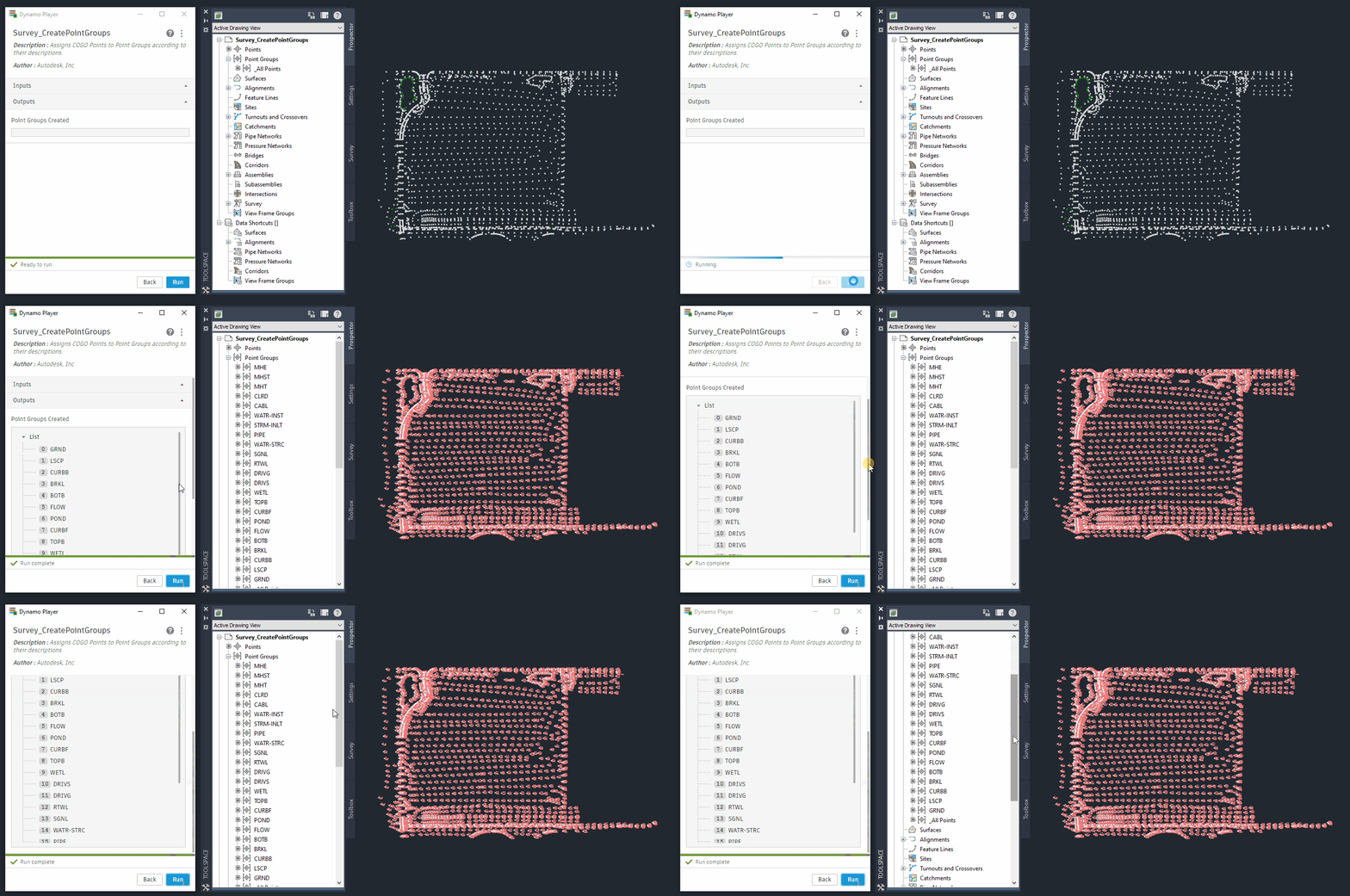
以下是使用 **Dynamo 播放器**執行圖表的範例。

<figure><img src="/files/QUatbEVHW85UpDQf20c9" alt=""><figcaption><p>使用 Dynamo 播放器執行圖表，然後在「工具區」中查看結果</p></figcaption></figure>

{% hint style="info" %}
如果您不熟悉 Dynamo 播放器，請查看 [Dynamo 播放器](/zh-tw/dynamo-for-civil-3d/dynamo-player.md) 一節。
{% endhint %}

> :tada: 任務完成！

## 構想

以下是一些如何擴充此圖表功能的構想。

{% hint style="info" %}
將點群組修改為根據 **完整描述** ，而非原始描述。
{% endhint %}

{% hint style="info" %}
將點分組，分組時依據您選擇的其他某些 **預先定義的品類** (例如，「地面快照」、「碑界」等)。
{% endhint %}

{% hint style="info" %}
為某些群組中的點自動建立不規則三角網地形。
{% endhint %}


---

# Agent Instructions
This documentation is published with GitBook. GitBook is the documentation platform designed so that both humans and AI agents can read, navigate, and reason over technical content effectively. Learn more at gitbook.com.

## Querying This Documentation
If you need additional information that is not directly available in this page, you can query the documentation dynamically by asking a question.

Perform an HTTP GET request on the current page URL with the `ask` query parameter, and the optional `goal` query parameter:

```
GET https://primer2.dynamobim.org/zh-tw/dynamo-for-civil-3d/sample-workflows/surveying/point-group-management.md?ask=<question>&goal=<endgoal>
```

`ask` is the immediate question: it should be specific, self-contained, and written in natural language.
`goal` is optional and describes the broader end goal you are ultimately trying to accomplish on behalf of the user. GitBook uses it to tailor the answer towards what is most useful for that goal.

The response will contain a direct answer to the question and relevant excerpts and sources from the documentation.

Use this mechanism when the answer is not explicitly present in the current page, you need clarification or additional context, or you want to retrieve related documentation sections.